Social platforms are good at helping people discover creators. They’re less reliable once you want to keep that audience close.
Telegram fills that gap. There is no recommendation algorithm deciding which subscribers can see your posts, you can publish almost any content format, and your most engaged followers can stay in one place for content, community, and paid access.
That makes Telegram less of a replacement for TikTok, Instagram, or YouTube and more of a second layer around them: build reach where discovery happens, move your strongest followers to Telegram, and give them a reason to stay.
This guide explains where Telegram fits in a creator business, how creators build an audience that sticks around, what makes people pay, and how tools like Tribute handle the operational side once money enters the picture.
Why creators are moving to Telegram
Creators use Telegram because it gives them direct access to people who have already chosen to follow them.
On Instagram, TikTok, YouTube, and Facebook, publishing does not guarantee that every follower will see a post. Ranking systems decide what appears in feeds.
Telegram works differently. Subscribers can open everything you publish in chronological order without an engagement algorithm filtering posts out of their channel.
That does not mean every subscriber will read every post. People still mute channels, stop opening them, or lose interest. But distribution is much less dependent on winning the algorithm again every time you publish.
For creators, that changes the role Telegram plays.
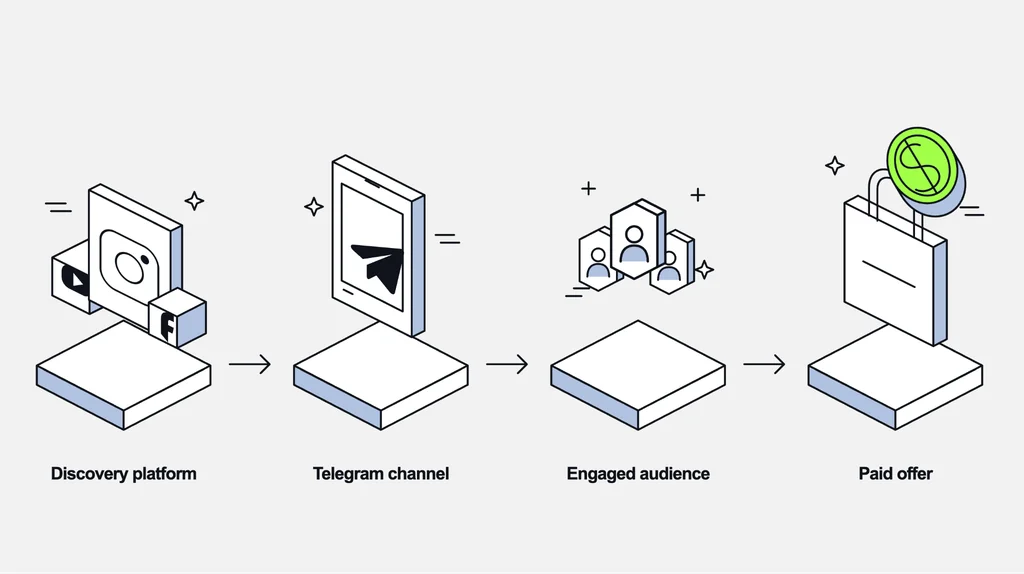
You can use public social platforms for reach and Telegram for the people who want more: deeper analysis, early access, direct updates, community, exclusive material, or paid content.
Where Telegram fits in the creator funnel
Telegram is strongest in the middle and bottom of the creator funnel.
TikTok, Instagram, YouTube, search, podcasts, and other public platforms help new people discover you. Telegram gives the interested ones somewhere to continue following you once that first interaction is over.
Instead of depending on someone seeing your next Reel or video, you can bring them into a channel built around a more direct relationship.
That might mean:
- deeper versions of your public content
- daily or weekly updates
- resources and downloads
- behind-the-scenes material
- direct conversations
- a private community
- paid content and products
The goal is not necessarily to move your entire following to Telegram. It is to move the people who care enough to want more.
That smaller group is often the part of the audience with the highest potential to become repeat readers, customers, members, or subscribers.
What makes Telegram different for content creators
Telegram gives creators more control over distribution and format, but less built-in discovery.
1. Direct distribution
Telegram does not use an engagement-ranked feed to decide which channel posts subscribers are allowed to see.
Once someone joins, your content stays available in the channel rather than competing for a slot in their feed every time you publish.
2. Flexible content
A Telegram channel can combine short posts, long analysis, photos, videos, voice messages, polls, files, links, comments, and downloadable resources.
You do not have to redesign every idea around one dominant format.
3. A closer audience relationship
Joining a Telegram channel is a more deliberate action than seeing a random short video in a feed.
That makes it useful for creators who want to move from broad reach toward repeat attention.
The trade-off is discovery.
Telegram is not going to hand you an audience the way a recommendation feed can. In most cases, you need to bring people in yourself.
Turning followers into Telegram subscribers
For most creators, Telegram growth starts outside Telegram.
Your first subscribers might come from:
- Instagram or TikTok
- YouTube
- X
- a newsletter
- your website
- a podcast
- another community
The important part is giving people a reason to make the jump.
“Join my Telegram” is not much of an offer.
“I post the full analysis and templates in Telegram” is.
Your channel should have a clear job that complements what you already publish elsewhere.
- A fitness creator might use Instagram for short workouts and Telegram for structured plans.
- A marketer might publish short takes on LinkedIn and send deeper analysis and resources to Telegram.
- A musician might use TikTok for discovery and Telegram for early releases, demos, and closer fan updates.
Once people join, growth becomes a retention problem too. If the channel does not deliver what they came for, the subscriber number can keep rising while the actual audience gets weaker.
That is why consistent positioning matters more than simply posting more.
For a niche-specific example of how acquisition, content, engagement, monetization, and retention fit together, see our guide to growing and monetizing a crypto Telegram channel.
What creators need to solve after the channel starts growing
Running a small free channel is simple. You publish, people read, and some reply or share the post.
As the audience grows, the harder questions are no longer just about content. You need to decide what stays free, what is worth paying for, whether the offer should be recurring or one-off, and how to keep the paid experience running without turning channel management into a second job.
That is where monetization creates operational work. Someone has to collect payments, give buyers the right access, manage renewals and cancellations, and deliver whatever they purchased.
You can handle that manually at a very small scale, but it gets harder quickly as more people start paying.
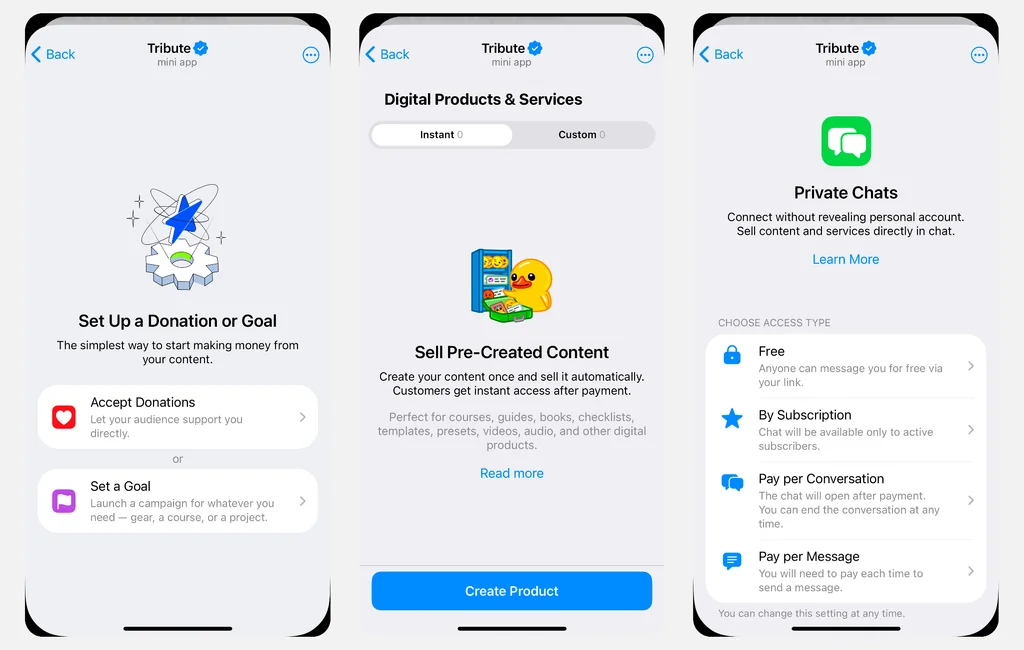
Tribute is built for this layer. It is a Telegram-native bot that lets creators sell subscriptions, products, donations, and paid access inside the platform while automating payments, delivery, and membership management.
Once the infrastructure is handled, the creator can focus on the more important question: what is the audience actually willing to pay for?
Who is actually earning on Telegram?
Tribute’s own data shows that creator monetization on Telegram is not limited to one type of content or niche.
Over the last 12 calendar months, over 30,000 creators generated earnings on Tribute, giving us a large sample of how different creator businesses perform.
Psychology, spirituality, and related content was the largest category in the sample, generating $16.8 million in gross sales over 12 months.
Technology creators, including AI channels, generated $7.2 million across 1,183 active creators.
Fitness and wellness creators generated $4.5 million, while lifestyle and personal-brand creators generated $4.4 million.
Here’s the broader picture.
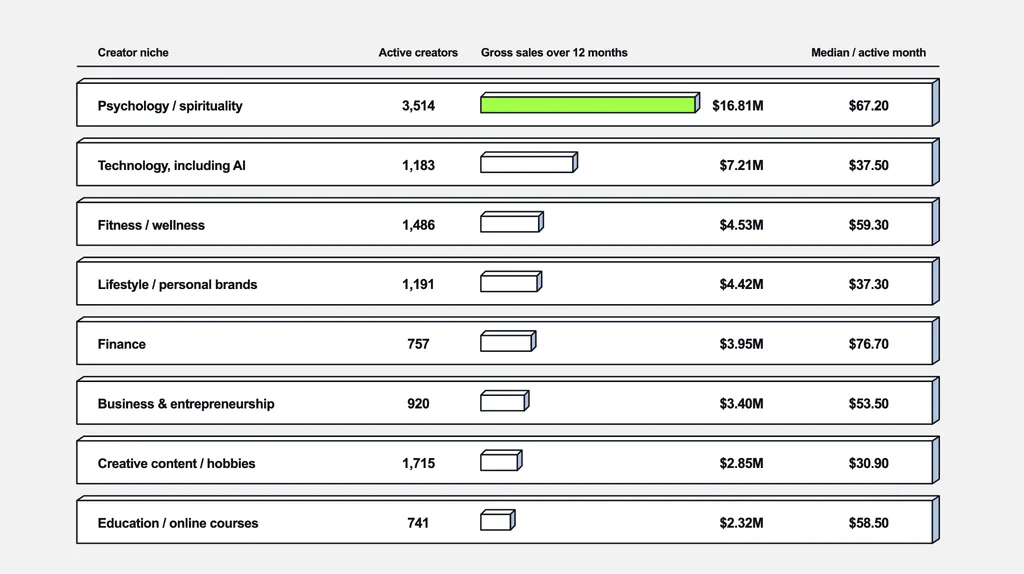
The monthly figure is calculated only across months when a creator had earning activity.
That distinction matters. The typical creator is not immediately making thousands of dollars a month. Across these niches, median gross sales per active month range from about $31 to $77.
But the averages are substantially higher.
Technology creators average $648.40 per active month, finance creators $581, psychology and spirituality creators $503.10, and business creators $419.50.
The gap between median and average shows that earnings are uneven: many creators start small, while a smaller group scales far beyond the typical level.
That is a more useful way to think about Telegram monetization than looking for one subscriber count at which a creator suddenly starts earning.
The first goal can simply be proving that part of your audience is willing to pay.
What people actually pay for on Telegram
Pricing also varies substantially by niche.
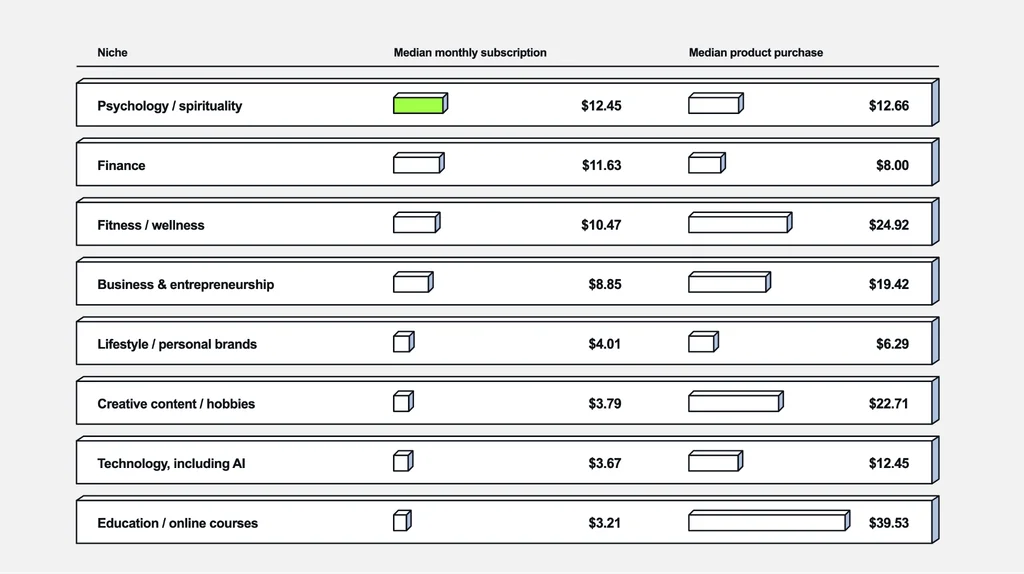
In Tribute’s data, the median monthly subscription payment ranges from around $3 to more than $12 depending on the type of creator.
These are actual amounts paid through Tribute, not listed prices.
The difference between subscriptions and products is useful when deciding what to sell.
Education creators, for example, have a median monthly subscription payment of $3.21, but a median product purchase of $39.53. For creative and hobby channels, those figures are $3.79 and $22.71.
The two models do different jobs.
A relatively accessible subscription can monetize an ongoing relationship. A higher-priced product can monetize a specific result, resource, course, file, or piece of content.
You do not have to choose between them forever. But you usually need one model to work before adding another.
For a deeper comparison of subscriptions, products, ads, donations, affiliate marketing, and other options, see our guide to Telegram monetization models.
What to Sell on Telegram as a Creator
Tribute’s data also shows how monetization tends to expand once a creator has an audience willing to pay.
Across five creator niches, roughly 1 in 4 to 1 in 3 creators within each niche use at least two monetization models.
The second model depends on the audience.
Donations are especially common among gaming creators, where 40.4% received at least one donation. The share is 32.3% for lifestyle and personal-brand creators and 31% for psychology and spirituality creators.
Digital products show a different pattern. 12.6% of technology creators, 11.5% of psychology and spirituality creators, and 8.8% of business creators sold at least one product during the period. It can be an ebook, a course, a webinar, or something else.
The practical takeaway is simpler.
Start with the revenue model closest to why people already follow you. Add another when the audience gives you a reason to.
If people want continuous access, a subscription is a natural starting point. If they repeatedly ask for a specific resource or outcome, package it as a product. If the main content stays free and the audience simply wants to support it, donations can sit alongside it.
For a broader list of income strategies, see how to make money on Telegram.
What should stay free, and what should become paid?
One of the harder creator decisions is deciding where free content stops and paid value begins.
A useful principle is to keep the content that drives discovery and trust free, then charge for additional depth, access, structure, or convenience.
| Free content | Paid layer |
| Short market updates | Full research and analysis |
| General fitness tips | Structured training plan |
| Public tutorials | Full course or templates |
| Selected artwork | Early releases and exclusive work |
| General expert advice | Direct access or consultation |
| Community content | Private member group |
The paid version should feel like a natural next step.
It should not feel like the creator suddenly removed everything useful from the free channel.
This also means you do not necessarily need a huge audience before testing a paid offer.
Pay attention to repeated requests.
If people keep asking for more detailed analysis, downloadable files, private advice, structured learning, or direct access, they are already showing you what the paid layer could be.
When a paid channel makes sense
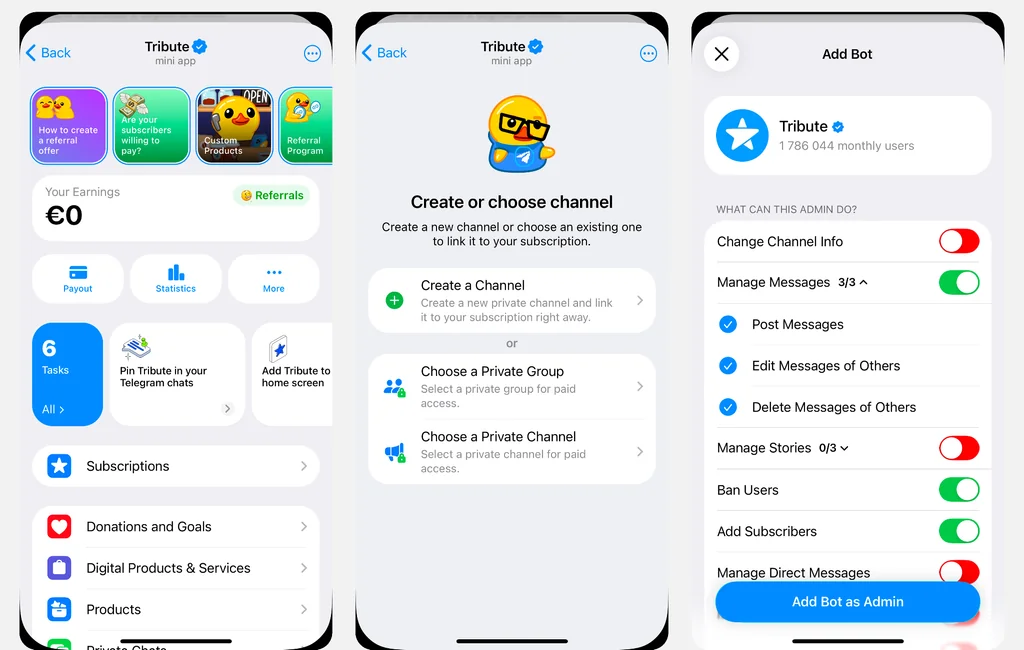
A private paid channel works particularly well when the value continues over time.
That could be:
- ongoing research
- educational content
- industry updates
- premium communities
- training programs
- exclusive creator content
- member-only resources
The key difference from a one-off product is recurrence.
People are not paying once for a single asset. They are paying to continue receiving access.
And the subscription price does not necessarily have to be high.
Across Tribute’s categorized creators, the median monthly payment is $12.45 in psychology and spirituality, $11.63 in finance, $10.47 in fitness and wellness, $8.85 in business, and $3.21 in education.
Those are industry benchmarks, not recommended prices.
What people will pay depends on what members receive, how frequently you deliver it, how specific the value is, and what your audience already pays for similar content or access.
Retention matters from day one too. The content has to keep giving members a reason to renew.
If recurring access fits your offer, our step-by-step guide to creating a paid Telegram channel covers channel setup, pricing, payments, launch, and getting your first paid members.
Why getting paid inside Telegram matters
Once someone has decided to buy, the next problem is friction.
Every extra step between intent and payment gives them another opportunity to leave.
A subscriber who has to open another site, understand a new interface, create an account, pay, then return to Telegram has a longer journey than someone who can buy from where they already consume the content.
This is where a Telegram-native monetization platform becomes useful.
Tribute lets creators run paid subscriptions, donations, digital and physical products, and paid interactions inside Telegram.
It handles the parts that otherwise become repetitive as the paid audience grows: payment, access, renewals, and delivery.
You do not need to build a separate website or membership system first.
Why do you need Tribute?
Consider a paid membership.
Without automation, the workflow can look like this: Payment → verify payment → give access → track membership → manage renewal → handle failed payment → remove expired access
Doing that for five people is easy.
Doing it repeatedly for 50, 100, or 500 members is a different job.
With Tribute, that lifecycle is automated.
A creator can focus on the offer and the content while Tribute handles the transaction and membership mechanics behind it.
The same principle applies to products. Instead of manually confirming a payment and sending the purchase, payment and delivery can happen as part of the same flow.
There are trade-offs.
Creators need to complete identity verification. Payouts follow a schedule instead of arriving after every individual transaction.
The benefit is that you do not have to build and maintain the payment and access infrastructure yourself.
Build reach elsewhere. Build the relationship in Telegram
Telegram does not need to replace the platforms where people already discover you.
Let TikTok, Instagram, YouTube, search, or other public channels do what they are good at: creating reach.
Use Telegram for the next layer.
Bring the people who want more into a channel where they can follow you consistently, get deeper content, join the community, and eventually buy something that fits the relationship you have built.
Tribute’s own data shows that creators are already doing this across education, fitness, finance, lifestyle, technology, creative content, and other niches — from small first sales to creator businesses earning far above the category median.
When that paid layer grows beyond what you want to manage manually, Tribute can handle payments, access, renewals, and delivery inside Telegram.
FAQ
Is Telegram good for content creators?
Yes, especially for retaining and monetizing an audience you already reach elsewhere. Telegram gives subscribers direct access to your channel without an engagement-ranked feed deciding which posts they can see. It is less powerful as a standalone discovery platform.
How do creators get subscribers on Telegram?
Most creators bring people from platforms where they already have reach, such as Instagram, TikTok, YouTube, X, a newsletter, website, podcast, or another community. A clear reason to join
How do I create a paid Telegram channel?
A paid channel normally combines a private Telegram channel with a system for taking recurring payments and managing access. See the complete guide to creating a paid Telegram channel for the setup process.
Do I need a website to sell through Telegram?
Not necessarily. A Telegram-native platform such as Tribute can handle payments, paid access, renewals, and product delivery without requiring a separate creator website or independent membership system.
What does Tribute charge?
Tribute charges a flat 10% commission on successful transactions. There is no starting deposit or monthly subscription fee, and payment processing is included in the commission.