Telegram marketing means using Telegram’s channels, groups, bots, and ads to reach an audience directly and, increasingly, to sell to that audience without sending anyone to an external checkout. With around a billion monthly users and no feed algorithm deciding who sees your posts, it’s one of the few places online where the people who follow you actually get what you publish.
The catch is discovery. Telegram won’t hand you an audience the way TikTok might, so you have to bring one and keep it.
This guide covers how it works, how to build a strategy, which tools earn their place, and how to turn attention into income.
What is Telegram marketing?
Telegram marketing is promoting and selling through Telegram’s native surfaces, including broadcast channels, discussion groups, automated bots, mini-apps, and paid ads, to reach people directly and convert them into subscribers, customers, or paying fans. It’s a branch of messenger marketing, and it works differently from email or social feeds in one important way.
Your messages arrive as notifications, not as posts an algorithm might bury. When you publish to a channel, every subscriber gets pinged (unless they mute the channel or a group). There’s no reach penalty for not paying, and no feed reshuffling your post below a hundred others.
That directness serves two different goals:
- Businesses use Telegram for reach and retention — a fast, reliable line to customers.
- Creators use it for revenue — a way to charge the audience they’ve already earned.
This guide covers both, but leans toward the creator’s side because that’s where Telegram has changed the most.
Why market on Telegram, and where it falls short
Telegram is worth it for three concrete reasons: near-total message delivery, high engagement, and a user base of roughly a billion people. But it’s weak on discovery and ad targeting, and pretending otherwise just wastes your budget.
The numbers are real. Telegram reported around one billion monthly active users in 2026, with roughly 450 million people opening the app daily, about 21 times a day on average.
Messages land, reactions are common, and forwards spread content across channels without a paid boost.
Now the honest part. Telegram has no algorithmic discovery feed, so nobody stumbles onto your channel the way they might a Reel. You import your audience from platforms that do have discovery, or from paid promotion.
And Telegram Ads target by interest and channel topic, not by age, gender, or location, because privacy is the platform’s whole design. Precise demographic targeting isn’t on the table.
The takeaway: Telegram rewards the audience you bring and the audience you keep, not one you hope an algorithm hands you.
Channels, groups, bots, and mini-apps: your marketing surfaces
Telegram gives you four surfaces to market on, and most strategies combine them: channels to broadcast, groups to discuss, bots to automate, and mini-apps to transact.
Each does one job well and none replaces the others.
| Surface | What it is | Best for | Main limitation |
|---|---|---|---|
| Channel | One-to-many broadcast, unlimited members | Announcements, content, paid access | One-way; no member-to-member chat |
| Group | Two-way chat, up to 200,000 members | Community, discussion, feedback | Needs active moderation to stay useful |
| Bot | Automated program you configure | Welcome flows, support, sales, polls | Setup effort; poor bots annoy people |
| Mini-app | A small app inside Telegram | Storefronts, loyalty, games | More technical to build |
Channels are the backbone of most Telegram marketing. They’re where you publish, and (if you charge for access) where paid subscriptions live.
Groups sit alongside a channel to give subscribers a place to talk, which surfaces which topics land and turns quiet readers into a community.
A Telegram marketing bot handles the work a solo creator can’t do by hand: greeting every new subscriber, answering FAQs at 2 a.m., running polls, or processing a sale. You can build one through @BotFather with some code, or use a no-code builder if you’d rather not touch a terminal.
Mini-apps go a step further, letting people shop or play without leaving the app — useful once you’ve outgrown simple posts.
How to build a Telegram marketing strategy
A working Telegram marketing strategy is five decisions made in order: goal, audience, positioning, content, and cadence. Skip them and you’re posting into the dark.
- Goal: Decide what the channel is for: reach, leads, or direct sales. The goal picks your tools and your metrics, so name it first.
- Audience: Define one clear subscriber: their problem, what they want, and why they’d choose Telegram over your other channels. One sharp persona beats a vague “everyone.”
- Positioning: Pick one role and own it. You’re either the curator who filters a niche, the expert who shares original knowledge, or the community hub where people gather. Channels that try all three at once confuse the people they’re trying to keep.
- Content pillars: Choose three to five recurring themes and rotate them. Pillars make planning easy and keep the channel coherent.
- Cadence: Consistency beats frequency. Posting two or three times a week on a schedule you can actually hold outperforms a daily sprint that burns out in a month.
A simple weekly template removes the daily “what do I post” decision.
| Day | Theme | Format |
|---|---|---|
| Monday | Framework or how-to | Text |
| Wednesday | News with your take | Text or image |
| Friday | Question or poll | Poll |
Batch a week of posts in one sitting and schedule them ahead. Strategy is just what turns random posting into a system you can measure and repeat.
How to grow and promote your channel
You grow a Telegram channel three ways — owned, earned, and paid — and for most creators the first two do the heavy lifting, because paid ads are gated (more on that below). Start where you already have reach.
- Owned are your strongest Telegram marketing channels early on: your other social profiles, your email list, your website, your link-in-bio. Point every existing follower toward the channel with a specific reason to join, something they get there and nowhere else.
- Earned growth comes from other people’s audiences: cross-promotion and shoutouts with channels in your niche, directory listings, and forwards from subscribers who found a post worth sharing. A single well-placed cross-promo with a channel your size often beats weeks of solo posting.
- Paid growth means ads, covered next.
One caution worth stating plainly: don’t use member-adder or scraped-list mass-DM tools to inflate your numbers. They violate Telegram’s rules, get accounts limited or banned, and leave you with a subscriber count full of people who never engage.
A thousand real subscribers are worth more than fifty thousand silent ones.
Telegram Ads: what they cost and who they’re for
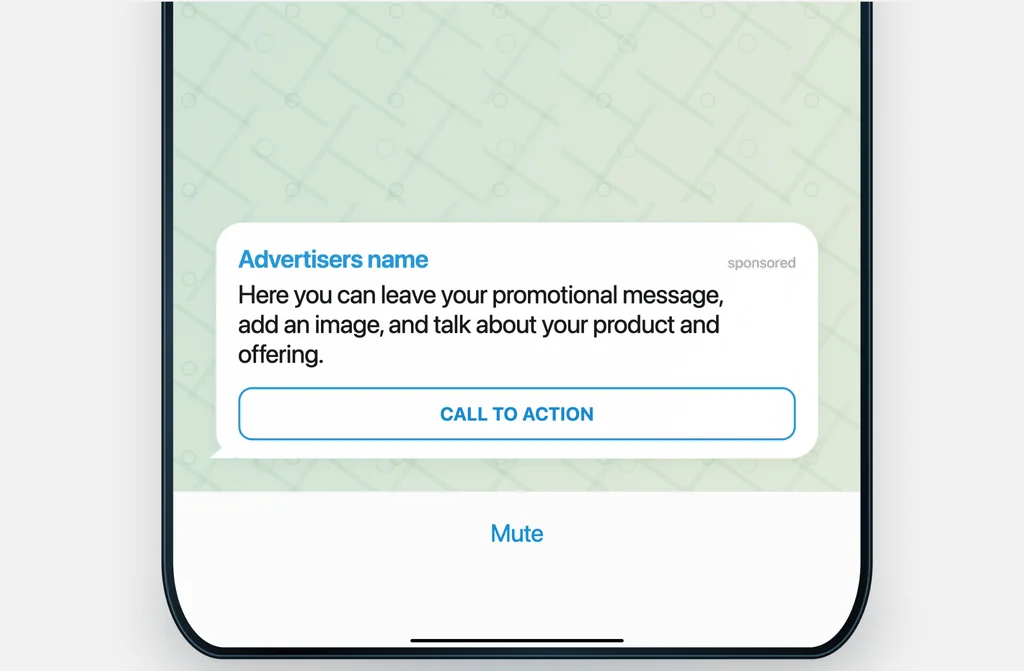
Telegram Ads is Telegram’s official self-serve advertising platform.
Ads appear as sponsored messages in public Telegram channels with at least 1,000 subscribers. The standard format is intentionally simple: a short text message with a link to a Telegram destination, such as a channel or bot.
Pricing works on a CPM auction. Telegram’s advertising guide lists a minimum CPM of 0.1 TON per 1,000 impressions, but the actual cost depends on competition for the channels and audiences you want to reach. A higher bid can increase your chances of winning impressions.
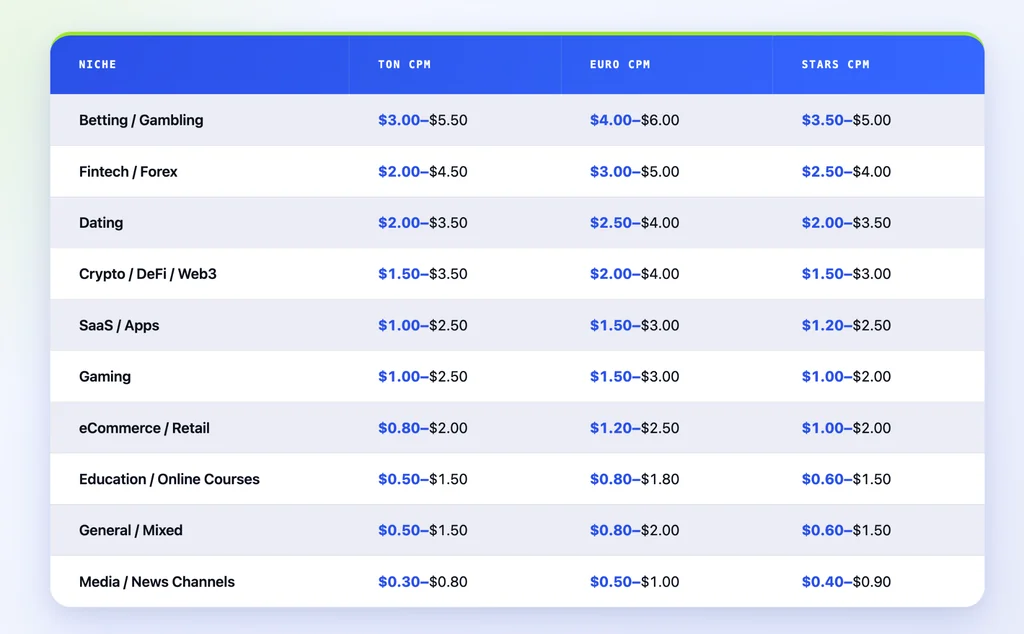
Targeting is primarily contextual rather than demographic. Advertisers can choose the topics, languages, and specific public channels where their ads should appear. Telegram does not use the content of private messages or detailed personal profiles for ad targeting. This makes the platform particularly useful when you already know which channels your target audience follows.
All ads go through moderation, and categories such as gambling, political advertising, tobacco, alcohol, certain financial products, and misleading or prohibited services face restrictions.
For creators and businesses, Telegram Ads makes the most sense when the goal is to grow a Telegram channel or bot and you have a clear idea of what a new subscriber or user is worth.
For smaller creators, it can still make sense to test direct placements in relevant channels, cross-promotions, and organic growth first. Once you understand which audiences convert, Telegram Ads gives you a more scalable way to reach similar users.
Telegram marketing tools and software
The useful Telegram marketing tools fall into four categories: scheduling, analytics, chatbots, and monetization, plus a fifth category you should avoid entirely.
| Category | What it does | Examples |
|---|---|---|
| Scheduling | Queue and auto-publish posts | Native scheduling, Controller Bot |
| Analytics | Track views, growth, engagement | Telegram Statistics, TGStat |
| Chatbots | Automate welcome, support, sales | No-code bot builders |
| Monetization | Take payments inside Telegram | Tribute |
Match the tool to the job rather than buying an all-in-one that does none of them well.That’s the legitimate half. The other half of what gets sold as “telegram marketing software” is grey-hat automation: member-adders, bulk scrapers, and mass-DM senders that promise thousands of contacts overnight. Skip them.
These Telegram marketing tools break platform’s terms of service, trip its spam detection, and get accounts banned — and the “audience” they deliver is contacts who never asked to hear from you and won’t buy. No amount of volume fixes a list that doesn’t want you there.
Telegram marketing agencies and services
A Telegram marketing agency is worth it when you have ad budget and no time. They handle channel setup, ad buying through funded accounts, and day-to-day management but you should vet them for retention, not just for subscriber counts. The gap between the two is where most agency money is wasted.
Full-service Telegram marketing services usually cover strategy, channel launch, ads management, channel-to-channel seeding, and community moderation.
The question to ask any of them is simple: do you optimize for engagement and retention, or for joins?
A campaign that adds 50,000 subscribers who mute you the next day is worse than one that adds 5,000 who read every post. Most creators don’t need an agency at all until there’s a real budget to put behind ads.
Turning marketing into money: how to monetize your Telegram audience
The point of all this reach is revenue, and Telegram now lets you collect it without sending anyone to an external site through paid subscriptions, donations, and digital or physical products sold inside the app.
You market to build the audience; you monetize to make the audience pay off.
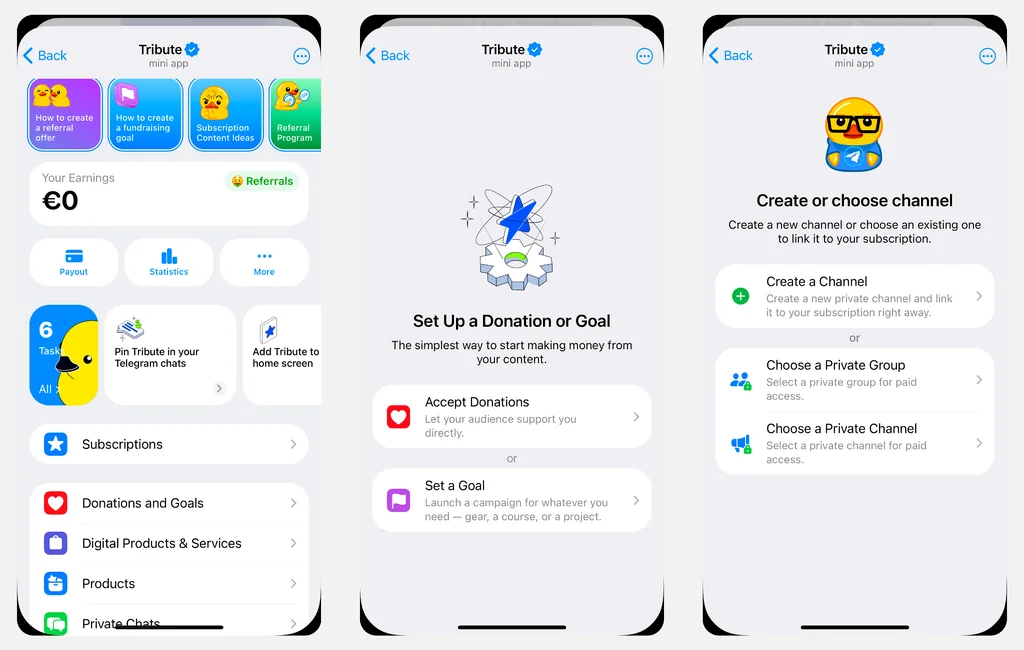
There are four native ways to earn:
- Subscriptions: recurring payment for access to a private channel or group, billed weekly, monthly, or yearly.
- Donations: voluntary support, one-time or recurring, including named goals your audience can fund together.
- Digital products: any file, video, or message sold as a product, including made-to-order work.
- Physical products: merch with variants, stock, and order tracking, published straight into a chat.
Tribute is one way to run all four through a single Telegram-native bot — a bot verified by Telegram that handles payment, access, and renewals inside the app, so there’s no separate website or Stripe account to set up.
Tribute accepts payments from any country by card, crypto, and Telegram Stars, and pays out twice a month once your balance passes the threshold of €100 or 100 USDT.
Tribute requires identity verification (KYC) because it processes real financial transactions — standard for anything that moves money, and your documents are used only to confirm who you are.
The tactics that actually turn subscribers into paying customers
The tactics that move revenue most are the ones that lower the first-purchase barrier and recover the sales you almost made — promo codes, gift subscriptions, offer discipline, and payment reminders.
Based on Tribute’s internal data across a base of more than 70,000 creators, these are where the measurable jumps come from.
1. Promo codes multiply what you already have
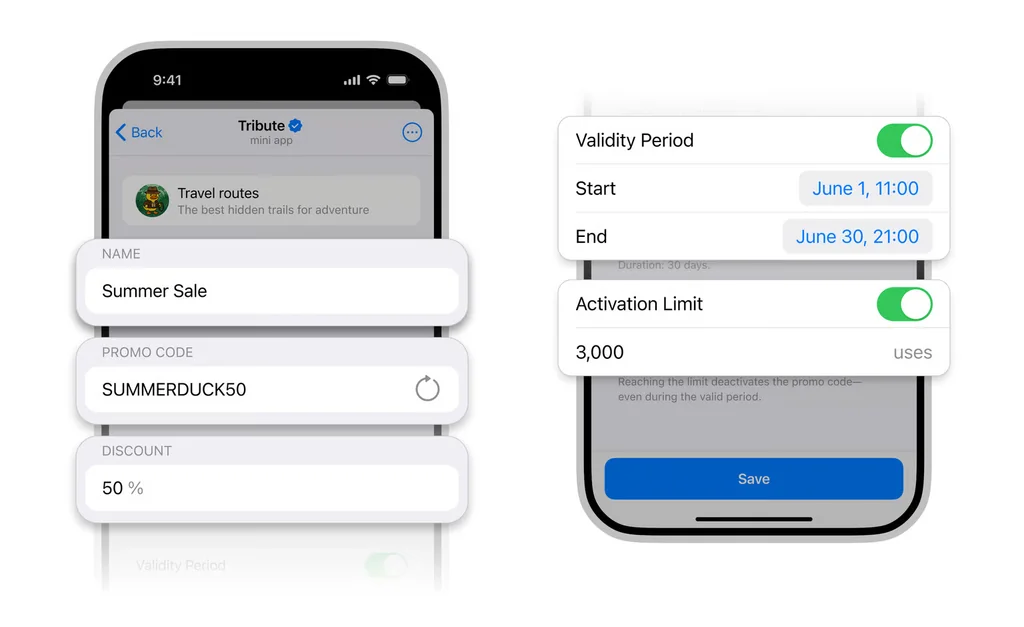
A promo code isn’t just a discount, it’s a lever that multiplies an audience you’ve already built. Based on Tribute’s data, well-run promo codes have lifted a creator’s monthly revenue by more than 40% in individual cases.
In one, a single month of promo-code campaigns drove 1,846 activations and hundreds of new subscribers with no extra ad spend.
Codes work because they give a warm audience a reason to act now instead of later. You can aim them at new subscribers, at people who churned, or at a specific segment you want back and track which code did the work.
For setup, see our full guide to promo codes in Tribute.
2. Gift subscriptions bring in new paying subscribers
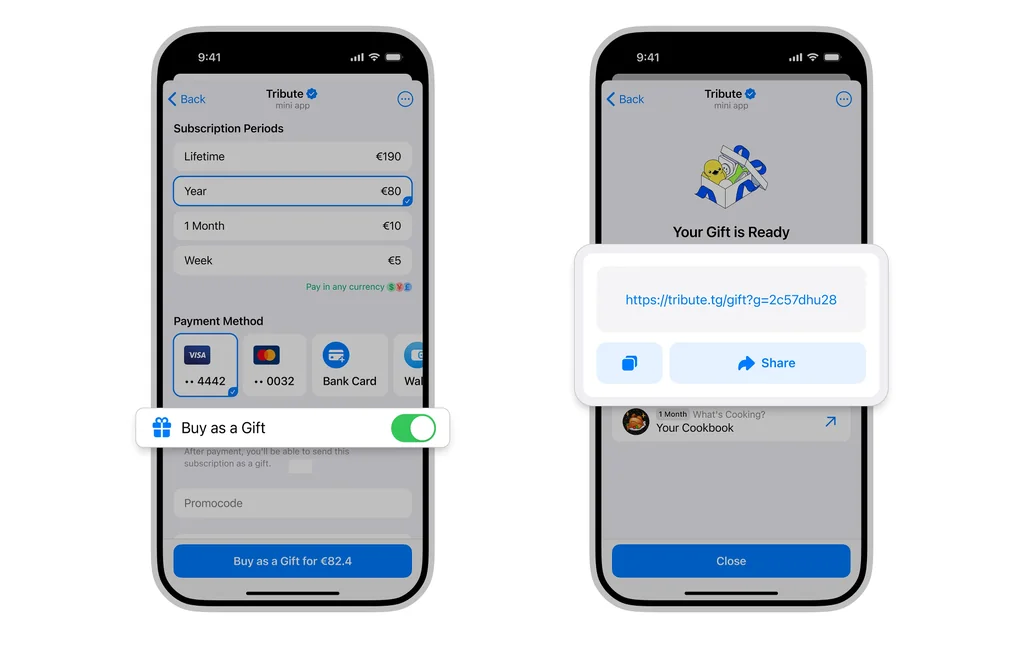
Gift subscriptions have an underrated use: they recruit new paying subscribers, not just reward existing ones.
Normally you lower the barrier for a newcomer yourself, with a discount, a trial, or free access. A gift flips that — the first paid experience of your channel is bought by someone who already thinks it’s worth paying for.
The data backs it up. Tribute looked at 7,977 people who received a gift subscription that later expired; after the gift ended, 592 of them, about 7.4%, paid for the same subscription on their own.
The recipient doesn’t arrive to try something free. They arrive because a friend paid for them with a clear message: this is useful to me, and I think it’ll be useful to you.
That’s a personal recommendation with the first payment already made, and for the person giving it, buying access for someone else quietly reconfirms the value they’re paying for themselves.
3. Don’t drown people in options
More offers don’t mean more sales past a certain point.
One large field study of 1.6 million shoppers found that as the number of recommended digital products (courses, ebooks, guides, etc.) went up, purchase probability rose at first, then dropped sharply. Too many choices stall the decision instead of speeding it.
The lesson for your channel: when you present subscription tiers or products, keep the menu short and the best option obvious. A clean choice between two or three plans converts better than a wall of ten.
4. Recover the payments people almost made
A reminder recovers far more sales than you’d expect, because an abandoned payment usually isn’t a hard “no.”
Tribute analyzed 16.8 million people who reached the payment screen but didn’t buy right away. After a single reminder, they came back and paid more than 200 times more often than those who got none.
The reason is human. Someone reaches checkout, gets distracted, closes Telegram, and means to finish later — but “later” turns into “forgot.” The reminder doesn’t hard-sell; it just returns the person to a decision they’d nearly made.
Tribute sends that reminder automatically, but the broader point stands: the people who already showed interest are the warmest part of your audience, and one reminder isn’t the end of the conversation. You can keep working with them through Broadcasts in Tribute — direct messages to an audience that’s already leaning in.
Common Telegram marketing mistakes
Telegram marketing usually goes wrong for fairly predictable reasons. The problem is rarely a lack of tactics. More often, channels focus on the wrong metrics, publish without a clear rhythm, or try to monetize before they have built an audience that actually pays attention.
- Chasing subscriber count over engagement: A large audience looks good on paper, but subscriber count tells you little about whether people actually read, click, reply, or buy. Track views, reactions, clicks, joins from specific sources, and eventually conversions instead of optimizing for the biggest possible number.
- Posting inconsistently: Telegram works partly because it becomes a habit — subscribers get used to seeing useful posts from you in their feed. Publishing several times in one week and then disappearing for two weeks makes that habit harder to build.
- Buying fake or low-quality growth: Cheap subscriber packages, scraped audiences, and unsolicited mass DMs may increase the number under your channel name, but they rarely create readers or customers. They can also distort your engagement metrics, making it harder to understand whether your content and acquisition channels are actually working.
- Publishing without a clear reason to stay: Getting someone into the channel is only the first step. If every post covers a different topic or simply repeats content available elsewhere, subscribers have little reason to keep opening it. Make the value of the channel obvious: a specific type of analysis, practical advice, curated news, exclusive content, community access, or another benefit people know they can consistently return for.
- Promoting too much: If every second post asks people to buy, subscribe, join another channel, or click a link, even engaged readers start tuning out. Promotional posts work better when they are surrounded by content that is valuable on its own. Give people a reason to keep reading even when they aren’t ready to buy.
- Monetizing before trust exists: Paid subscriptions, products, consultations, and donations work best when your audience already understands what you provide. Asking for money immediately after attracting subscribers creates friction because they haven’t yet seen enough value to justify paying. Build a useful free layer first, learn what your most engaged readers want more of, and monetize around that demand.
Turn attention into revenue with Tribute
Growing a Telegram audience is only part of the job. Once people trust your channel, the next step is giving them a simple way to support you or pay for more.
Tribute lets you sell subscriptions, digital products, consultations, and accept donations directly inside Telegram, without building your own payment flow. If your channel is ready to monetize, you can start with one simple offer and grow from there.
FAQ
Is Telegram good for marketing?
Yes. Telegram works especially well for businesses and creators that want direct access to an audience without relying entirely on algorithmic feeds. Channels are useful for publishing content, while groups, bots, paid subscriptions, and ads can support engagement, automation, and monetization.
How do you grow a Telegram channel?
Start with a clear reason to subscribe, publish consistently, and promote the channel where your existing audience already spends time. Cross-promotions, partnerships with relevant channels, Telegram Ads, social media, SEO, and referral campaigns can all bring new subscribers. Track which sources bring engaged readers rather than focusing only on total subscriber count.
How often should you post on Telegram?
There is no universal posting frequency. For many channels, a few strong posts per week work better than publishing several low-value updates every day. The important part is choosing a cadence you can maintain and monitoring views, reactions, clicks, and unsubscribes.
How much does Telegram marketing cost?
Organic Telegram marketing can cost very little if you already have an audience to promote to. Paid growth varies widely depending on the niche and method. You can buy placements directly from other channels or use Telegram Ads, where advertisers bid for impressions on a CPM basis.
Are Telegram Ads worth using?
They can be useful when you know which channels your target audience reads and have a clear way to measure the value of each new subscriber or bot user. Smaller channels may want to test organic growth, partnerships, and direct placements first before scaling with paid ads.
What should you track in Telegram marketing?
Useful metrics include post views, reach as a percentage of subscribers, reactions, link clicks, subscriber growth, acquisition source, unsubscribes, and conversions. If you monetize the channel, also track purchases, paid subscriptions, renewals, and revenue per subscriber.
Can you make money from a Telegram channel?
Yes. Common models include paid subscriptions, digital products, consultations, donations, sponsorships, affiliate offers, and Telegram’s own ad revenue sharing. Tools such as Tribute can handle payments and access for subscriptions, products, and donations directly inside Telegram.
How many subscribers do you need before monetizing?
There is no fixed minimum for most monetization models. A small but engaged audience can generate more revenue than a much larger passive one. It usually makes sense to monetize once you understand what your audience values enough to pay for.