

You’ve probably seen a “Pay with Stars” button and wondered what you’re actually paying with, how the payment goes through, and, if you make content, whether it’s worth accepting.
Telegram Stars are Telegram’s in-app currency for buying digital goods and services inside the app, and paying with them takes a single tap.
This guide covers the whole picture: how the payment system works end to end, the methods buyers use to get Stars, what the checkout interface looks like, and what it costs a creator to actually get paid. If you sell anything digital on Telegram, the last part is the one that matters most.
What are Telegram Stars?
Telegram Stars are Telegram’s in-app currency for paying for digital goods and services without leaving the app. Telegram launched them in June 2024, and in the Bot API they’re represented by the currency code XTR.
You spend Stars on things like paid posts, bot features, mini-app purchases, digital products, and tips or gifts to creators. A buyer tops up a Star balance once, then spends from it across the app, no card entered per purchase.
Stars aren’t a cryptocurrency, even though they can later be converted into one. Until you convert them, Stars are Telegram’s property, tied to your account, and earned Stars that go unused expire after three years. That distinction matters when you’re deciding how much of your income to route through them.
How the Telegram Stars payment system works
The Stars payment system runs entirely inside Telegram: a buyer turns real money into Stars, spends them in one tap, and the creator later converts the earned Stars into cash. Nothing leaves the app until the final cash-out.
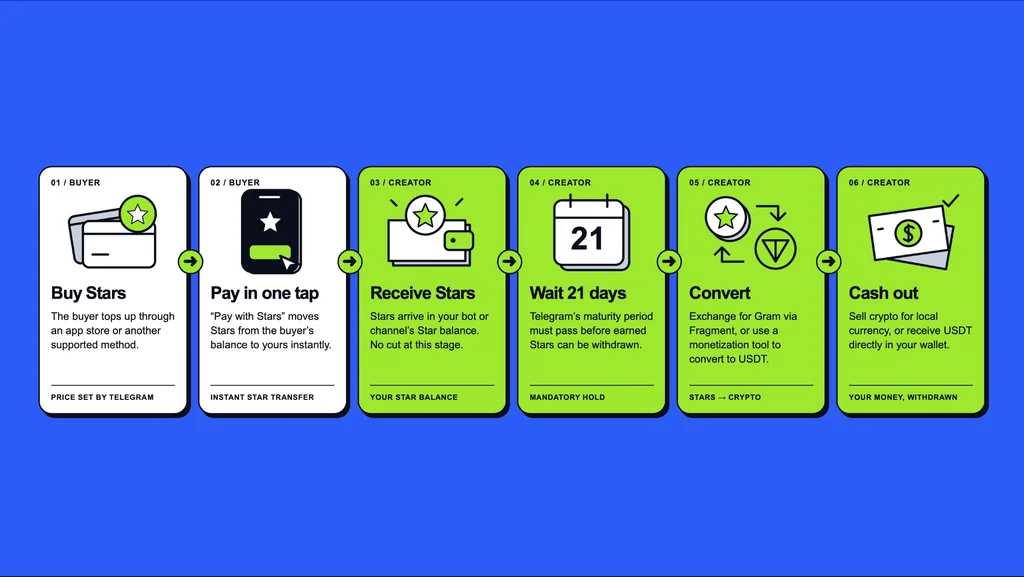
Here’s the full chain, step by step:
- Buy: The buyer purchases Stars through the app store or using other methods described later at a rate Telegram sets.
- Spend: The buyer taps “Pay with Stars,” and the Stars move from their balance to yours instantly.
- Receive: The Stars land in your bot or channel’s Star balance, with no cut taken at this stage.
- Hold: Telegram applies a 21-day maturity period before earned Stars become withdrawable.
- Convert: You exchange Stars for Gram (formerly TON) through Fragment, or let a monetization tool convert them to USDT for you.
- Cash out: You sell the crypto for your local currency, or receive USDT directly to a wallet.
One structural detail shapes everything downstream: the buyer pays the app-store markup up front when they buy Stars, and the creator’s cost shows up later, at the conversion and withdrawal stage. Keep that split in mind, it’s why the “fee” for Stars is easy to misread.
How to buy Stars: payment methods
You buy Stars inside Telegram with Apple Pay, Google Pay, or a bank card, and more cheaply on desktop or through Fragment, because those routes skip the app-store cut.
On mobile, Apple and Google add roughly a 30% markup that’s baked into the Star price.
| Method | How it works | Cost note |
|---|---|---|
| In-app (iOS / Android) | Settings → My Stars → Buy More Stars | Apple/Google add ~30% |
| Desktop / Web | Same flow, no app-store layer | Cheaper, no 30% cut |
| @PremiumBot | Buy Stars through the bot | Desktop-style pricing |
| Fragment | Buy with crypto (Gram/TON) | Often cheapest; needs a wallet |
The practical takeaway: The exact price of 100 Stars depends on where and how the buyer purchases them. Someone buying on an iPhone pays more per Star than someone buying on a laptop, for the same Stars.
One safety rule is worth stating plainly. Buy only through official surfaces. A legitimate seller never asks for your Telegram password or a login code. Anyone who does is running a scam.
What the Telegram Stars payment interface looks like
The payment interface is a single in-chat invoice with a “Pay with Stars” button, no card form, no redirect, no personal details entered. That’s the whole point of it.
When a buyer taps to purchase, Telegram shows a confirmation with the Star price and their current balance. They tap confirm, the Stars are deducted, and the content or access unlocks in the same chat. The buyer never types a name, a shipping address, or a card number, because Stars were already loaded earlier.
Two honest details sit behind that smooth checkout:
- Star payments are final, there are no chargebacks, and refunds happen only if the seller issues one, which a buyer can request with the /paysupport command.
- For developers, the interface is built with a sendInvoice call using currency: “XTR”; that’s the entire integration on Telegram’s side.
Fewer form fields means fewer places to abandon the purchase. For low-priced digital items, that reduced friction is the strongest thing Stars has going for it.
How creators get paid with Stars
Creators earn Stars when buyers pay for digital content, keep the full Star amount at the transfer stage, then convert those Stars into money under Telegram’s rules. Telegram takes no cut when the Stars move to you, the cost lands at cash-out.
The manual route has three constraints worth knowing before you rely on it:
- There’s a 21-day hold before earned Stars can be withdrawn,
- A 1,000-Star minimum (roughly $13) to withdraw at all,
- And the path to cash runs Stars → Gram (formerly TON) → fiat through Fragment, with a market spread at the conversion step.
For a creator used to instant settlement, that timeline is a real cash-flow factor.
Stars land in your balance the moment a buyer pays, but turning them into money you can actually spend follows its own rules, which are worth understanding before you build income around them. Our full guide to earning Telegram Stars as a creator walks through the mechanics in detail.
Most of that friction comes from doing the Fragment conversion by hand. A monetization tool can take it off your plate.
Accepting Telegram Stars payments with Tribute
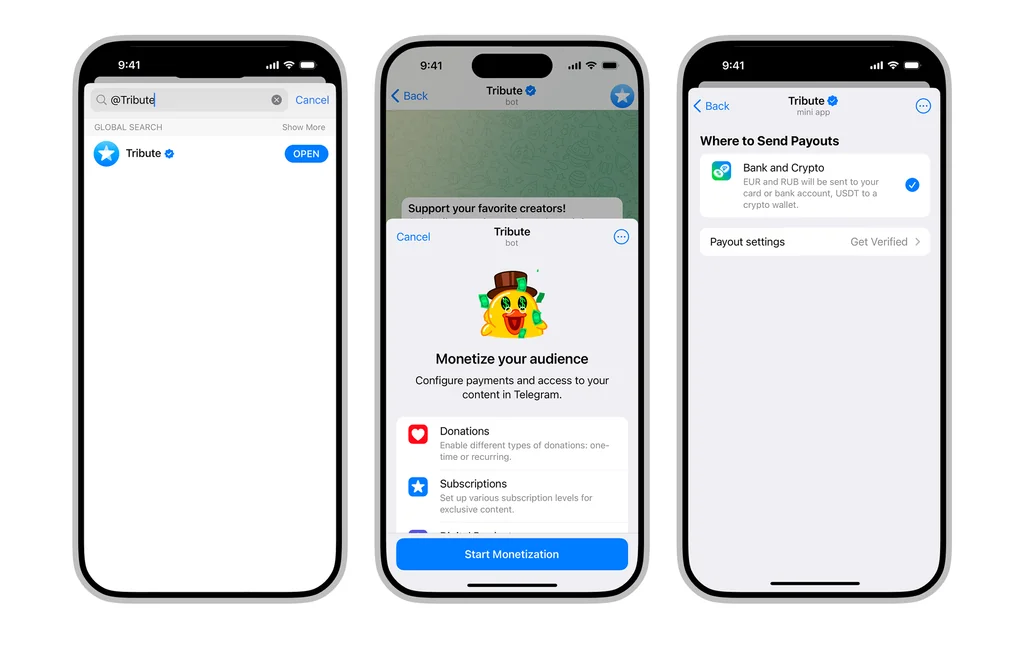
Tribute is a monetization platform built into Telegram. It’s a bot, @Tribute, that lets creators get paid by their audience without routing anyone through an external website or checkout. Payment, delivery, and access to whatever you sell all happen inside the app.
For Stars specifically, Tribute lets you accept them for digital products and get paid in USDT, no code and no manual Fragment conversion. You set a product up once, and the accept-and-cash-out part is handled for you.
Here’s how it works on Tribute:
- Pricing: Set a fixed price directly in Stars, or price in euros and let Tribute convert to Stars at Telegram’s rate.
- Conversion: The buyer pays in Stars, Tribute converts them to USDT, and the USDT is paid to your @walt.
- Commission: A flat 10% covers Tribute’s service fee and payment provider fees together, with no tiers.
- Payout: Star revenue pays out in USDT to @walt twice a month, on the 10th and 25th, once your balance clears the 100 USDT threshold.
- Consistency: Your payout is the same no matter how the buyer bought their Stars: the full Star value, minus the 10%.
If Stars are your entry point, it’s worth knowing the rest of what Tribute does, because it’s built around keeping the whole transaction inside Telegram.
You can run paid subscriptions with trials and promo codes, collect donations, set up crowdfunding with a specific goal, sell digital and physical products, and charge for one-on-one access through Private Chats, all without sending your audience to an external checkout.
Stars vs other ways to get paid on Telegram
Tribute accepts all three — Telegram Stars, bank cards, and crypto, so the real decision isn’t which platform to use, but which method to put in front of each buyer.
Stars fit low-friction, one-tap digital sales. Cards suit subscriptions and the widest reach. Crypto suits cross-border and crypto-comfortable buyers.
| Telegram Stars | Bank card | Crypto (Walt Pay) | |
|---|---|---|---|
| Buyer needs | Only Telegram | A bank card | A crypto wallet |
| Best for | Micro digital sales | Subscriptions, broad reach | Cross-border, crypto-comfortable |
| Works for (on Tribute) | Digital products | Subscriptions, donations, products | Subscriptions, donations |
| Recurring billing | No | Yes | Yes |
| Buyer-side cost | ~30% app-store markup on mobile, built into the Star price | Dynamic service fee, smaller on larger purchases | No service fee on Walt payments |
| Payout on your own | Gram (formerly TON) via Fragment, after a 21-day hold and a 1,000-Star minimum | Needs a payment tool for digital goods | USDT or TON to a wallet you manage |
| Payout via Tribute | USDT to @walt |
EUR or @walt |
USDT to @walt |
You don’t have to commit to one rail. A common setup is to use Stars for cheap, impulse digital buys where checkout friction kills sales, and cards or Walt Pay for subscriptions where recurring billing and lower conversion costs matter more.
Match the method to the buyer and the price point.
Getting started
If you sell digital content on Telegram, Stars is one honest way to get paid — low friction for buyers, and no card processor to set up.
The part that usually trips creators up is the cash-out, and that’s the part Tribute handles: price in Stars, get paid in USDT, and keep the whole transaction inside Telegram. Open @Tribute to set up your first product.
FAQ
What is a Telegram Star worth?
Roughly a couple of US cents per Star, though the exact price depends on the buyer’s country and whether they bought on mobile or desktop. Telegram sets the rate, and it drifts over time, so treat any single figure as approximate.
How do I pay with Stars?
Tap the “Pay with Stars” button on a paid post, product, or bot, confirm the amount shown against your balance, and the Stars are deducted instantly — no card form appears. If your balance is short, Telegram prompts you to top up first.
What payment methods can I use to buy Stars?
Apple Pay and Google Pay in the mobile app, a bank card on desktop or web, @PremiumBot, or Fragment with crypto. Desktop and Fragment are cheaper because they skip the app-store markup that mobile purchases carry.
Are Telegram Star payments refundable?
Star payments are final and can’t be charged back, but the seller can choose to issue a refund. A buyer requests one with the /paysupport command, and it’s then up to the creator or bot to process it.
How do creators withdraw Stars?
Manually, you convert Stars to Gram (formerly TON) through Fragment, then sell that for your local currency on an exchange — after a 21-day hold and once you’ve reached the 1,000-Star minimum. With Tribute, Stars are converted to USDT and paid to your @walt automatically, so you skip the manual conversion.
Can I use Stars for subscriptions on Tribute?
Noб on Tribute, Stars are for digital products. Recurring income like paid subscriptions and donations runs on cards or Walt Pay, which support automatic renewals that Stars don’t.
Is there a fee to accept Stars?
Telegram takes no cut when Stars transfer to you, but the buyer absorbs the app-store markup when they buy Stars, and converting Stars to cash through Fragment adds a spread. On Tribute, you pay a flat 10% and receive USDT, with no separate conversion step to manage.