
Patreon works well until its limits start getting in the way: low engagement, content restrictions, limited ways to sell, or a community that rarely returns to the platform.
The best alternative should solve those problems without making payments, content, or member access harder to manage. A good fit for a writer may be very different from one for an artist, musician, coach, or 18+ creator.
This guide compares the main Patreon alternatives by monetization, community features, restrictions, and migration, with a closer look at Telegram as a home for a paid community.
What are the best Patreon alternatives in 2026?
There’s no single best replacement for Patreon. The right choice depends on what you sell and where your fans already are.
Most sites like Patreon fall into five groups, and each one solves a different problem. When you’re comparing alternatives for Patreon, pick the type first and the tool second.
| Platform type | Examples | Best for | Main trade-off |
| Messenger-based | Telegram paid channels, donations and digital product sales via a bot like Tribute | Communities, experts, creators whose fans already use Telegram | Content lives in a feed, not a course library |
| Tip jars | Ko-fi, Buy Me a Coffee | Casual fan support | Few community tools |
| Newsletters | Substack, Ghost | Writers | Built around written posts and email |
| Course and community platforms | Podia, Mighty Networks, Kajabi | Structured programs and courses | Monthly subscription cost |
| Adult-focused | OnlyFans, Fansly, SubscribeStar | 18+ creators | Covered in the adult content section below |
A note on free Patreon alternatives: no platform is truly free. “Free” tools skip the monthly bill and take a cut of each payment instead, which is how Patreon works too. What you can get for free is the space itself. Creating a Telegram channel costs nothing, and you only pay a fee when a fan pays you.
This guide spends most of its time on the messenger option, for a practical reason. It’s the one group on the list where fans don’t need to visit or install anything new.
Before comparing platforms like Patreon in detail, it helps to be clear about why you’re leaving.
Why are creators looking for a Patreon alternative?
Most creators leave Patreon for three reasons: fees went up for new creators in August 2025, posts struggle to reach members, and the relationship with your audience lives on Patreon’s terms.
1. How much does Patreon take in 2026?
Patreon takes 10% of every payment from creators who published their page after August 4, 2025, plus payment processing on top. Creators on older legacy plans may still pay 5%, 8% or 11%.
The platform fee is only the first layer:
- Payment processing: for US dollar payments, that’s 2.9% + $0.30 per payment.
- Currency conversion: an extra 2.5% applies when a member pays in a different currency from your payout currency.
- iOS in-app purchases: Apple takes 30% of purchases made inside the Patreon iPhone app, falling to 15% after a year of continuous billing. It replaces the processing fee, but Patreon’s 10% still applies.
Here’s what that looks like at a modest scale.
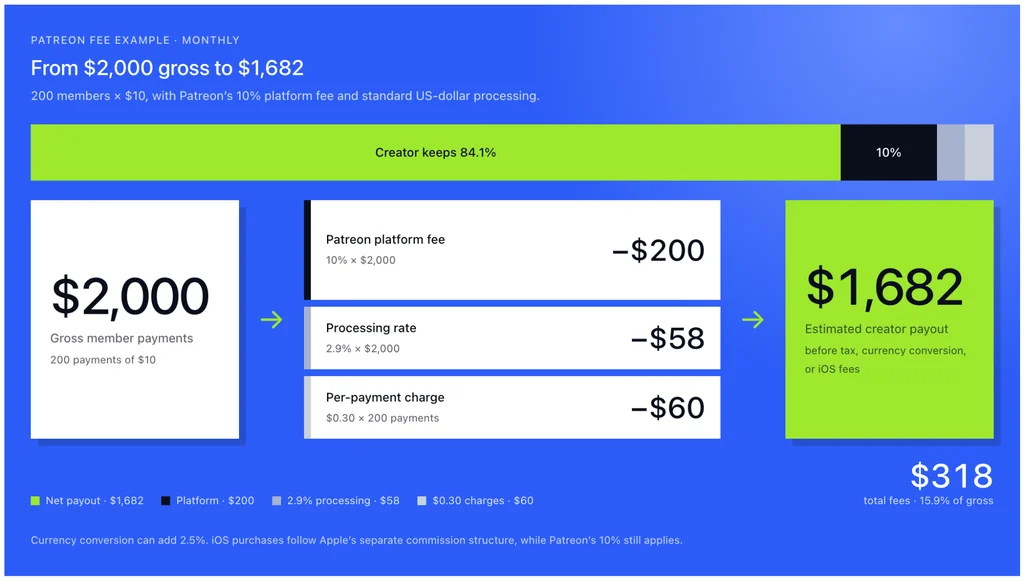
- Say you have 200 members paying $10 a month, or $2,000 in total. Patreon’s 10% is $200.
- Processing adds 2.9% ($58) plus $0.30 for each of the 200 payments ($60), so $118.
- That’s about $318 a month, roughly 16% of your gross, before any currency conversion or iPhone sign-ups.
One more date if you’re an existing creator: Patreon requires everyone still on legacy billing models, like per-creation or first-of-the-month billing, to switch to subscription billing by November 1, 2026.
The 10% fee is the floor, not the total.
2. Your posts compete with every other app
On Patreon, members see your updates when they open the Patreon app or catch the notification email. Your post is one more item in one more inbox.
Reach is where Telegram does better than Patreon for many creators. A post in a Telegram channel arrives as a message in an app people already check throughout the day, next to chats with their friends and family. There’s no separate destination to remember.
3. You rent the relationship
Your member list lives on Patreon. You can export a CSV with member emails, but if you move, every patron has to sign up and enter payment details again somewhere else.
That’s true of any hosted membership site, not just Patreon. It’s still worth knowing before you build your whole income on one.
If those problems sound familiar, the next question is whether a messenger can actually do Patreon’s job.
Patreon vs Telegram: how do they compare?
Patreon is a membership website with an app; Telegram is a messaging app where your paid community sits right next to your fans’ chats. The real trade-off is structure versus proximity.
| Patreon | Telegram paid channel (via @Tribute) | |
| Where fans read | Patreon app or website | Telegram, alongside their chats |
| How updates arrive | App notifications and email | Message notifications from your channel |
| Community | Posts, comments, community chats | Channels, groups and comment threads |
| Payment methods | Cards, PayPal, Apple in-app purchases | Cards, ApplePay, Google Pay, crypto, Telegram Stars for some products |
| Platform fee | 10% plus processing for new creators | 8-10% flat commission, no added costs |
| Content formats | Posts, video, audio, shop | Any Telegram message: text, video, files, voice, livestreams |
| Archive | Collections plus a chronological feed | Chronological feed with pinned posts |
| Discovery | Limited | Limited; growth comes from your free channel and other platforms |
| 18+ content | Allowed on Adult/18+ pages with rules | Allowed with restrictions on impersonation, deepfakes and non-consensual content |
Patreon still wins in three places. Collections give members an organized archive, the brand is familiar to fans who’ve never opened Telegram, and it suits web-first audiences who find you through YouTube or search.
Telegram wins on proximity. Fans already open the app daily, posts arrive as messages, and a paid channel can sit next to a free one and a discussion group without anyone leaving the app. For communities built on frequent updates and conversation, that’s the bigger advantage.
Telegram can replace Patreon. There are two ways to set it up.
How does Telegram work as a Patreon alternative?
You create a private channel and charge for access, either with Telegram’s built-in Star Subscriptions or with a subscription bot that adds card payments, tiers and retention tools.
The first is quicker to start; the second is closer to what Patreon does.
Option 1: Telegram Star Subscriptions
Telegram lets channel owners create special invite links that require a monthly payment in Telegram Stars, the app’s in-app currency. It’s built into Telegram, so there’s nothing to install.
Two limits matter:
- Stars only: fans have to buy Stars first, through the App Store, Google Play or by card on desktop.
- Monthly only: there’s no weekly, quarterly or annual billing.
It’s the fastest way to test whether people will pay at all.
Option 2: a subscription bot
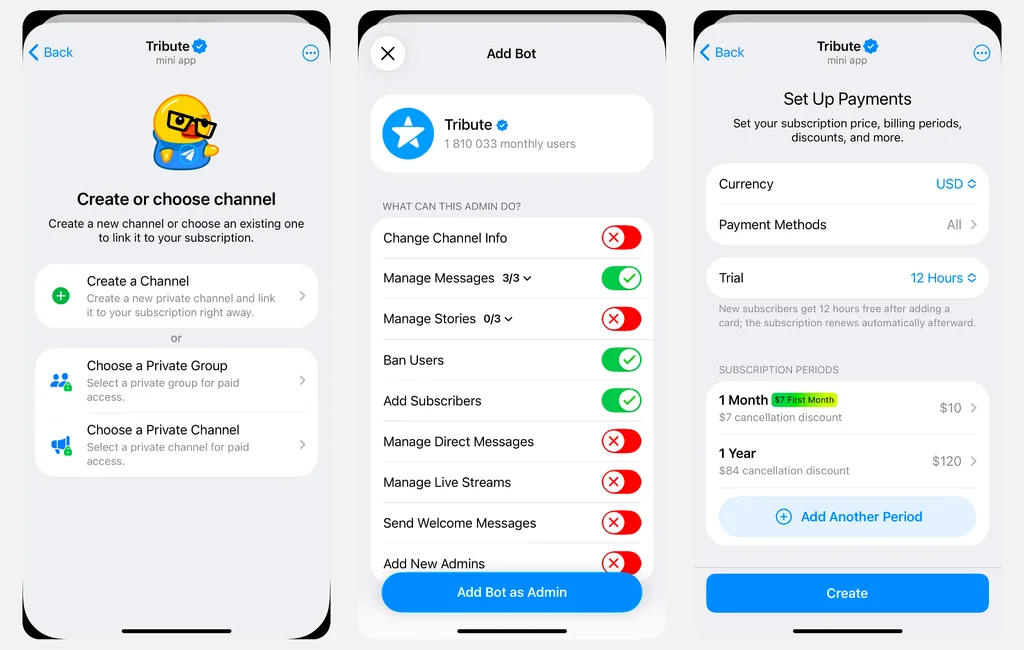
A subscription bot joins your channel as an admin and runs the business side of a Telegram paid subscription. It takes payment, adds the subscriber and removes them if they don’t renew.
Fans can pay by card or crypto without buying Stars first. Several bots do this job. Tribute (@Tribute) is one of the best, and it’s verified by Telegram.
If you want Patreon-style tiers and billing in a paid Telegram channel, a bot is the closer match.
What does Tribute add to a Telegram paid channel?
Tribute turns a Telegram channel into a full membership business: tiered subscriptions, donations, digital products and paid one-to-one chats, with payment and access handled by one bot inside Telegram.
You connect @Tribute to your channel as an admin, and your fans never leave the app to pay.
Membership tiers, the Patreon way
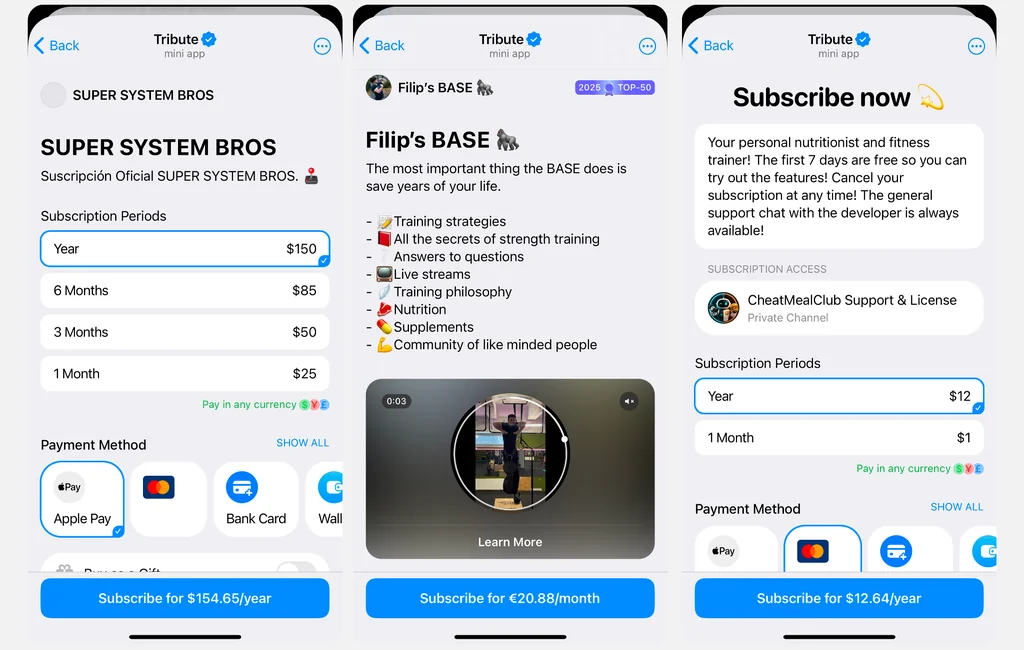
You can sell one-time, weekly, monthly, three-month, six-month and annual subscriptions. There’s no cap on tiers per channel or on the number of channels you monetize.
When someone pays, the bot adds them to your private channel. It reminds them before the subscription ends and removes them if they don’t renew. Fans with a saved card renew automatically, and gift subscriptions are on by default, so a fan can buy access for someone else.
Tools that keep patrons from churning
Most of the tools you’d use to monetize a Telegram channel over time are about keeping members, not finding new ones. Tribute covers the moments when people usually drop off:
- Free trial: new subscribers get 1, 12 or 24 hours, or 3 or 7 days, free, and it converts to paid automatically with a linked card.
- First-period discount: new subscribers can get 10–90% off their first billing period.
- Retention discount: members who try to cancel see a one-time offer of 10–90% off the next period.
- Payment retries: when a renewal fails, Tribute retries for 7 days before removing the member, and it cites around 50,000 subscriptions a month cancelled for insufficient funds.
- Promo codes: you can share a code or a link with 1–99% off the first payment already applied.
Keeping a member is cheaper than finding one, so these settings earn back the time they take. Read more about Telegram marketing tactics in our guide.
Tips, donations and goals
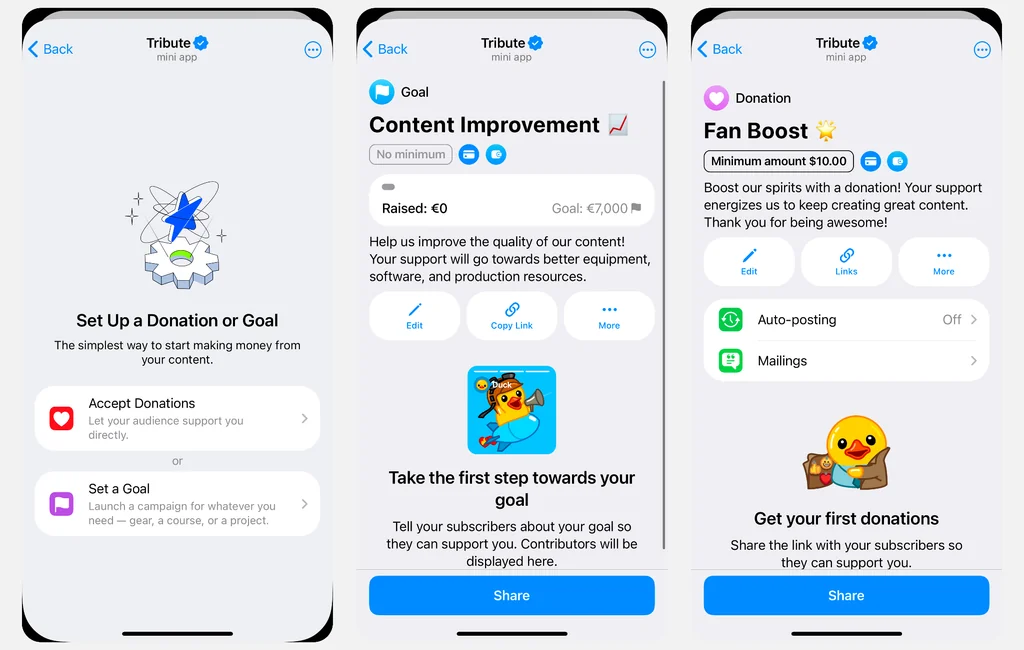
Donations work the way Patreon’s original model did: fans support you because they value your work, not to get something specific in return. They can give once or set up a recurring donation.
You can also run named goals with visible progress, such as funding new equipment. Streamers can show donation alerts live through the OBS integration.
Selling beyond memberships
A creator with Tribute can sell more than access:
- Digital products: any Telegram message or file, from a PDF guide to a video lesson.
- Custom products: made-to-order work like personal video messages or commissioned art, delivered through the bot.
- Private Chats: paid one-to-one conversations, including a mode where fans write for free and pay to see your reply.
For the full range of Telegram monetization, including ads and sponsorships, see our guide to Telegram revenue models.
Can you get paid in crypto instead?
Yes. With Walt, fans pay for subscriptions and donations in Gram (formerly TON), USDT or BTC, and the amount converts to USDT for you.
Digital products can also be sold for Telegram Stars, which pay out in USDT to @walt. If you’re looking at cryptocurrency alternatives to Patreon, this matters: Patreon doesn’t accept crypto, and here fans pay without leaving the chat app they already use.
Fees, payouts and verification
Tribute charges creators a flat 10% of each successful transaction, and that already includes payment provider fees. Subscribers pay a separate service fee on subscriptions, donations and digital products. The percentage drops as the payment grows, and it doesn’t apply to Walt or physical goods.
Fans can pay by card from any country. Payouts arrive on the 10th and 25th of each month once your balance reaches €100 or 100 USDT, either to a bank card or to @walt.
Before you can earn, Tribute asks you to verify your identity. It’s a standard Know Your Customer (KYC) check for services that process payments, and your documents are used only to confirm who you are.
Same Patreon mechanics, inside the app your fans already open.
Which Patreon alternative fits writers, artists and bands?
Writers usually do best on a newsletter platform or a Telegram channel, artists on a tool that sells commissions alongside memberships, and bands on one that combines fan support, merch and livestream alerts.
Here’s how that plays out for each.
Patreon alternatives for writers
If you write long essays and want them delivered by email, Substack and Ghost are the natural fit. Both are built around posts and newsletters, and readers expect that format.
Telegram suits a different kind of writing. Serialized fiction, short daily columns and posts that spark debate work well in a channel with a comment group underneath.
You can sell finished ebooks or PDFs as digital products and run a donation goal for your next book. Readers get each chapter as a message instead of an email they might never open.
Patreon alternatives for artists
Ko-fi is a common pick for artists who mainly want tips and a commission queue.
On Telegram, a paid channel works well for works in progress, sketches and early access. Commissions become custom digital products: a fan places the order, you deliver the file through the bot, and payment is released after a quick moderation check.
Brush sets and print files sell as digital products, and physical prints as physical products. Your commissions, community and shop live in one place.
Patreon alternatives for bands and musicians
For selling albums and tracks, Bandcamp remains the default for many independent musicians.
Telegram works as the fan club around it. A paid channel can carry early releases, demos and voice notes from rehearsals, and fans hear them the moment you post.
Donation goals give fans a concrete target, like funding the next record, and OBS alerts show support live on stream. Merch sells through physical products with size and colour options.
If you’re used to running raffles for patrons, note that Patreon doesn’t allow paid-entry raffles. The FAQ below covers what to do instead.
Your niche changes the tool mix, not the principle: go where your fans already read.
Which Patreon alternatives allow adult content?
If you’re comparing alternatives to Patreon for adult content, start with Patreon’s own rules. Several popular guides claim Patreon bans adult material outright. It doesn’t, and knowing what it actually allows helps you decide whether moving is worth it.
Of the Patreon alternatives that allow adult content, Telegram is the most practical choice for many 18+ creators.
You run a private paid channel inside an app your fans already use, and a payment bot like Tribute handles subscriptions under standard content rules. Patreon allows adult work too, but with tighter limits on what fans can see before they pay.
Does Patreon allow NSFW content?
Yes, on pages categorized as Adult/18+. The conditions are specific:
- Consent: you need written consent from every real adult shown in your work, and Patreon provides a form for it.
- Verification: creators in the Adult/18+ category confirm they’re over 18, a requirement that comes from Patreon’s payment processors.
- Public previews: anything visible without paying, including post and product previews, can’t show nudity or explicit material.
- AI limits: hyperrealistic AI-generated adult imagery faces extra restrictions.
Patreon clarified these rules in an update finalized in early 2026, renaming the section “Adult/18+ Works”. For many creators, the preview rules are what push them to look elsewhere.
Where do adult creators usually go?
Patreon alternatives with adult content fall into two groups: messaging platforms like Telegram, and sites built only for 18+ subscriptions.
Dedicated Patreon NSFW alternatives, such as OnlyFans, Fansly and SubscribeStar’s adult site, are built around a creator profile that fans visit to subscribe. Each has its own fees and content rules.
Telegram works differently. Your paid channel sits in the same app as your fans’ everyday chats, so new posts arrive as messages instead of waiting on a site fans have to remember to open. That’s the main reason creators pick it: content, community chat and payments all stay in one app people already check daily.
Can you run an 18+ paid channel on Telegram?

Yes. Telegram’s terms of service prohibit illegal pornographic content on publicly viewable channels and bots. So adult work goes in a private paid channel, and any public channel you use for promotion stays safe for work.
Tribute doesn’t restrict adult content as a category. Its rules are the standard safeguards you’d expect from any platform, and they cover consent and legality, not the kind of adult work you make:
- Age and consent: everyone featured, including people in the background and voice-only contributors, needs documented proof of age 18+ and written consent.
- No impersonation or deepfakes: your content can’t pass itself off as someone else, though stage names are fine.
- No non-consensual or exploitative content: this covers anything involving minors, escort services, and forced or simulated non-consensual acts.
- No filming where you’re not allowed to: nudity filmed where public nudity is illegal, or without the location owner’s permission, is off-limits.
Once those are covered, you run an adult channel like any other. You get subscription tiers, trials, promo codes, custom products for personal requests and paid private chats.
Read Tribute’s full content restrictions before you connect a channel.
What are the best alternatives to Patreon for adult artists?
The best alternatives to Patreon for adult artists depend on how you sell. Patreon’s Adult/18+ pages already allow illustrated, animated and written adult work with non-real characters, as long as every character is clearly an adult. Some artists stay there for the archive.
Telegram suits artists who earn from commissions as much as from memberships. A private channel carries works in progress and finished pieces. Commissions run through custom digital products, and packs or sets sell as digital products. The same age rule applies on Tribute: no character can be, or appear to be, under 18.
Rules for adult content on Patreon alternatives differ in the details, but the core is the same everywhere. Whichever alternatives to Patreon with adult content you choose, the rule holds: verified ages, written consent, and nothing explicit in public.
Should you stay on Patreon or move to Telegram?
Stay on Patreon if your members are web-first and rely on a structured archive. Move to Telegram if your fans already follow you there and you want payments, community and updates in one app.
- Stay on Patreon if: most of your audience finds you through YouTube or search, your archive matters more than frequent updates, or you’re on a legacy plan with a lower fee.
- Move to Telegram if: your free audience already reads you there, you post often and want those posts seen, or you want tips, products and paid chats next to your subscription.
- Run both if: you want Patreon’s archive for web-first fans and Telegram for the day-to-day community.
Running both is a valid answer, and it’s a low-risk way to test demand before you commit.
How do you move from Patreon to Telegram without losing patrons?
Mirror your Patreon tiers in a private Telegram channel, give existing patrons a reason to switch, and run both platforms in parallel until most members have moved. Here’s the order that works:
- Create your channels. Set up a private channel for paying members and, if you don’t have one, a free public channel for everyone else.
- Connect a subscription bot. With Tribute, open @Tribute, press Start and pass verification, which takes from a few minutes to an hour. Then add the bot as an admin with rights to post, edit and delete messages and create invite links.
- Copy your tiers one to one. Match your Patreon prices and benefits first. You can simplify once everyone has moved.
- Give patrons a reason to switch. A first-period discount or a promo link with the discount already applied makes the move feel like a perk, not a chore.
- Announce it everywhere. Post the link on Patreon and email your members using the CSV export from your Patreon dashboard.
- Keep Patreon running for at least one billing cycle. Close new sign-ups there once most of your members have moved.
Some members won’t switch, and that’s normal. Plan for a gradual move rather than a hard cutover.
If your fans are already on Telegram, you can set up tiers, trials and payouts for your paid channel in Tribute in a single session, then invite your patrons over at your own pace.
FAQ
Are there free alternatives to Patreon?
No platform is completely free. Free alternatives to Patreon skip the monthly fee and take a cut of each payment instead. A Telegram channel costs nothing to create, and you only pay a fee when a fan pays you.
How much does Patreon take from creators?
Patreon takes 10% from creators who published after August 4, 2025, plus payment processing. A 2.5% conversion fee applies when currencies differ, and Apple takes 30% of purchases made in the iPhone app.
Can I use Telegram instead of Patreon?
Yes. A private channel with Star Subscriptions or a subscription bot covers memberships, tips and digital products. A bot adds card payments, more billing periods and retention tools such as trials and discounts.
Does Patreon allow adult content?
Yes, on pages categorized as Adult/18+, with written consent, creator age verification and safe-for-work public previews. Most Patreon alternatives with adult content apply similar age and consent rules, so check them before you move.
What are the alternatives to raffles on Patreon?
Patreon treats raffles where patrons pay for a chance to win as gambling, so they aren’t allowed. Creators use giveaways that are free to enter and open to all fans instead, or a higher tier with limited slots for rewards they can’t offer everyone. Check your local giveaway laws before running any prize draw.
Are there cryptocurrency alternatives to Patreon?
Yes. Patreon doesn’t accept crypto, but on Telegram, Walt lets fans pay in Gram (formerly TON), USDT or BTC, and creators receive USDT to @walt.