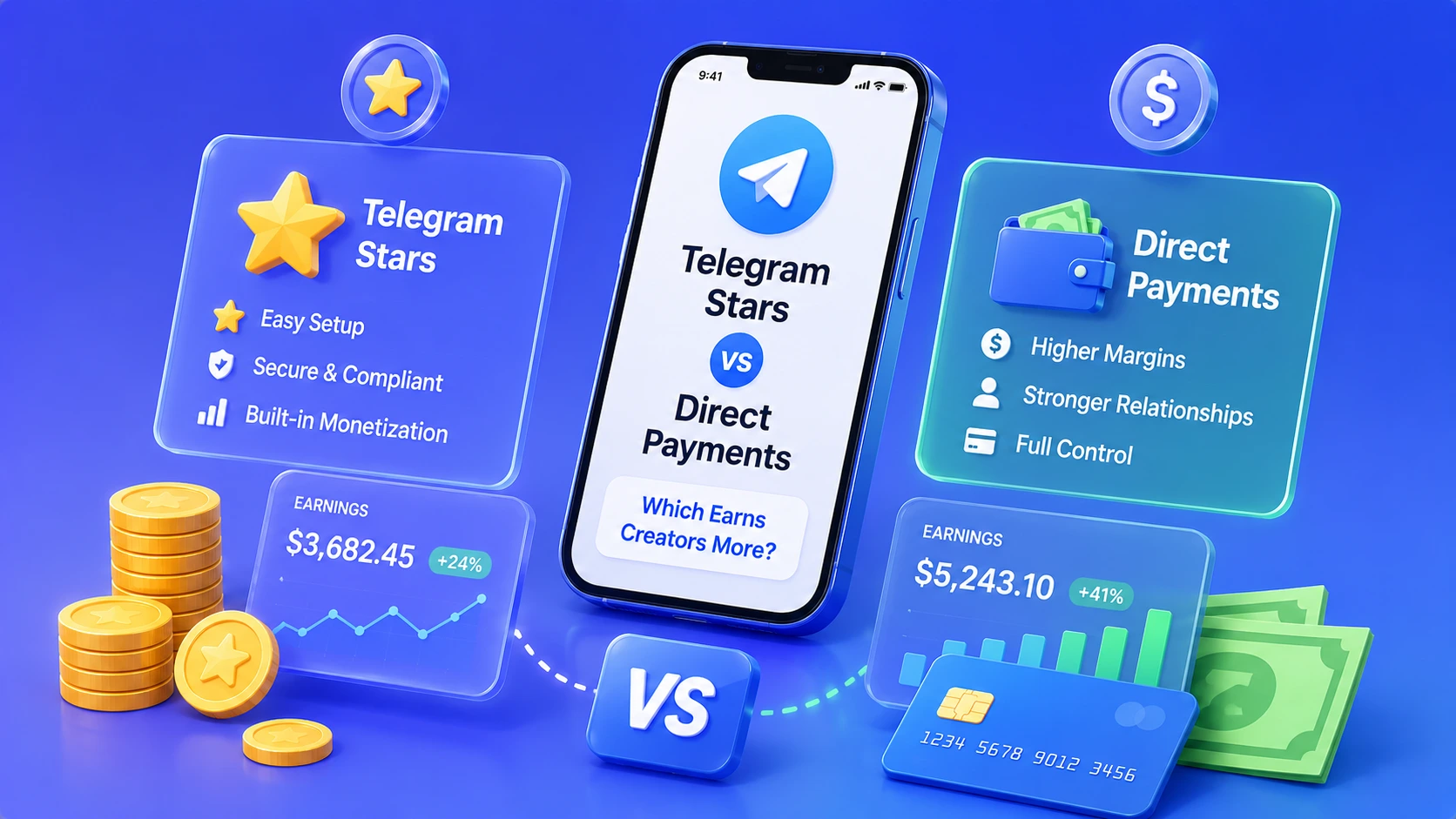
Telegram Stars launched in mid-2024 and have since become the default in-app currency for paid reactions, paid posts, channel subscriptions, and digital purchases inside the app. They have been good for Telegram and good for many creators. But there is one question creators rarely get a clean answer to: when a fan sends you a $10 Star payment, how much do you actually receive at the end of the chain?
This article walks through the real economics of Telegram Stars in 2026, compares them step by step to direct payment services like Tribute, and gives you a decision framework for when each method earns you more. We will use US and EU pricing throughout, and the numbers are based on Telegram's own documentation, Fragment's published rates, and the standard Apple and Google in-app purchase fee structure.
How Telegram Stars actually work: the six-step flow
Before talking about money, the mechanics. Stars travel through a six-step chain from the fan's wallet to your bank account.
- Step 1. The fan acquires Stars. Either through an in-app purchase on iOS or Android, or through Fragment.com using TON cryptocurrency.
- Step 2. The fan spends Stars. On a paid reaction, paid post, channel subscription, or in a bot or mini-app you operate.
- Step 3. You receive 100% of the Stars sent. Telegram does not deduct anything on the creator side. This is important, because it is often misreported.
- Step 4. The Stars sit on a 21-day hold. New Stars become eligible for withdrawal three weeks after they are received.
- Step 5. You withdraw via Fragment. Stars are converted into TON cryptocurrency on Fragment.com at the current rate.
- Step 6. You convert TON into local currency. Through a crypto exchange (Bybit, OKX, Binance) into USD or EUR, then to your bank account.
Six steps, four of which involve a third party that takes a small piece. Telegram itself is not one of those parties. That is the structural fact most guides get wrong, and it matters for the analysis below.
Where the money actually goes: the real economics
Let's run a clean example. A fan wants to give you $10 of support. Here is what happens to that $10 depending on how they bought their Stars.
Two key observations from this table.
First: Telegram does not take a creator-side commission. This is genuinely accurate. The $3 you lose on mobile is not Telegram's revenue, it goes to Apple or Google as a standard in-app purchase fee. The same 30% applies to in-app purchases in any iOS or Android app that uses the native payment systems. Telegram has no leverage to change that.
Second: the loss is real regardless of who collects it. For practical purposes the creator on mobile receives about 67% of what the fan intended to spend. On desktop or via Fragment with TON, that improves to about 96%. The desktop math is excellent. The mobile math is the issue, and roughly 80% of Telegram activity happens on mobile.
Direct payments: a different economic model
Direct payment services operate outside the in-app purchase system. The fan pays with a Visa or Mastercard card, or in cryptocurrency, directly to a payment processor. There is no Apple or Google involvement, because the transaction is not classified as an in-app purchase of a digital good provided by the messenger.
Tribute is one example of this model. Tribute is a verified Telegram monetization service that accepts card and crypto payments from fans, takes a flat 10% commission, and pays creators on a regular schedule directly to a bank card or stablecoin wallet. There is no 21-day hold, no manual conversion through Fragment, no exchange step. The economics on the same $10 example look like this:
Important nuance. Direct payments do not replicate everything Stars can do. They are not designed for micro-amounts. A $0.20 paid reaction is not viable on a card payment, because card processor fees would eat the entire transaction. They also lose some of the in-flow magic of a single tap inside the messenger. The two models serve different price points and different fan behaviors, and that is the framework for the rest of this article.
Where Stars win, where direct payments win
This is the practical part. Both methods are legitimate. The right one depends on what you sell, who buys it, and how much.
Stars are the better choice when:
- Your typical transaction is small. Anything between $0.10 and $3, especially paid reactions, single locked posts at low price points, or tip-style support.
- Your audience is global and uneven on banking. Fans in regions with limited Visa or Mastercard access can still buy Stars through the App Store or Google Play in their local payment method.
- Friction matters more than fees. A two-tap payment that never leaves the chat is a different product from a checkout page that asks for card details, even if the checkout page is cheaper.
- You're monetizing impulse engagement. A viral post that gets thousands of micro-reactions earns more in aggregate through Stars than it ever would through anything else.
Direct payments are the better choice when:
- Your typical transaction is $5 or more. Subscriptions, courses, digital products, custom services, physical goods. The percentage difference compounds fast at higher tickets.
- You are building recurring revenue. Subscriptions need predictable, regular payouts. A 21-day hold plus a manual Fragment withdrawal makes cash flow forecasting hard.
- Your audience is in the US, EU, or LATAM with normal banking. These fans are already comfortable paying with a card, and the Stars purchase path adds steps for them, not removes them.
- You need money in a bank account in fiat. Stars become TON, which becomes USD on an exchange, which becomes a wire to your bank. Direct payment services skip all of that.
A real example: a $10 monthly subscription with 1,000 subscribers
To make this concrete, let's run a realistic creator scenario. You run a private channel with 1,000 paying subscribers at $10 per month. Total gross fan spend is $10,000 per month. Here is the comparison.
The difference is roughly $1,640 per month, or $19,680 per year. That is real money. And that is before accounting for the operational simplicity of being paid in fiat on a regular schedule, with proper invoices for tax reporting, instead of managing a crypto wallet and an exchange account.
Note that this assumes a mobile-heavy audience, which is realistic for Telegram. If your subscribers are heavy desktop users who buy Stars through Fragment with TON, the Stars math improves considerably. But for the typical creator with a mostly mobile audience, the gap is what the table shows.
The hybrid strategy: most creators should use both
The honest answer is not that direct payments are better than Stars, or that Stars are better than direct payments. The honest answer is that they are tools for different jobs, and the best creator setups use both.
Use Stars for: paid reactions on regular posts, single low-price paid posts, mini-app payments, support from international fans without card access, anything where friction matters more than fee percentage.
Use direct payments for: recurring subscriptions, digital products at $5 and up, courses, consulting and custom services, physical goods, anything where the price point makes the fee math meaningful and you need predictable cash flow.
In practice this means turning on paid reactions to capture low-friction engagement income on top of your main monetization, while running subscriptions and product sales through a direct payment service that pays you efficiently. The two channels do not cannibalize each other. Star reactions cost the fan two taps and a few cents. A subscription is a different decision entirely, and the same fan often does both.
Beyond fees: five operational differences
Fee percentages are only part of the picture. Five other factors matter when you are choosing between the two methods, and they all favor direct payments for serious recurring monetization.
Payout timing. Stars enforce a 21-day hold from receipt before withdrawal eligibility, plus manual steps to convert through Fragment and an exchange. Direct payment services pay on regular intervals, often weekly or biweekly, with no manual conversion.
Payout currency. Stars end as TON, which is a cryptocurrency. To get fiat in your bank you need an exchange account and a withdrawal route. Direct services pay in USD, EUR, or stablecoins directly to a card or wallet.
Bookkeeping and tax. Direct payment services generate standard invoices, transaction histories, and documents that any accountant can use. The Stars → TON → exchange chain is harder to reconcile and may require crypto-specific tax handling depending on your jurisdiction.
Refunds and disputes. Card payments have a standardized chargeback and dispute resolution system. Stars transactions have a more limited refund mechanism, which is a feature for the creator in some cases and a limitation in others.
Audience friction. Stars are extremely low friction for fans already inside the Telegram ecosystem with Stars in their balance. They are higher friction for fans who need to buy Stars first. Card payments are familiar e-commerce flow for any audience used to online shopping.
Frequently asked questions
Does Telegram take a commission from creators on Stars?
No. Telegram passes 100% of Stars sent to the creator's balance. The fees in the chain come from Apple and Google on the purchase side, and from Fragment and the crypto exchange on the withdrawal side. Telegram itself does not deduct anything.
How much does a creator actually receive per $1 spent by a fan in Stars?
Roughly $0.65 to $0.80 if the fan bought Stars through the iOS or Android app, and roughly $0.95 to $0.97 if they bought through Fragment using TON. The difference is almost entirely the Apple or Google in-app purchase fee.
What is the minimum Stars withdrawal?
1,000 Stars, which is roughly $13 in USD value at current Fragment conversion rates. Below that threshold, Stars cannot be withdrawn and must accumulate first.
How long until earned Stars can be withdrawn?
21 days from the date each Star is received. This is a hard rule and applies to every transaction individually.
Can creators avoid the Apple and Google 30% fee?
Not directly, because the fee is collected on the fan's purchase, not on the creator's earnings. The fan can avoid it by buying Stars through Fragment with TON, but most casual fans do not do this. If your audience is technical and crypto-friendly, you can encourage Fragment purchases. For most audiences, the 30% is a structural feature of the mobile purchase path.
When does a direct payment service make more sense than Stars?
For any transaction above $5, for recurring subscriptions, for predictable cash flow, for fiat payouts to a bank, and for audiences that prefer card payments to in-app purchases. In practice this covers most serious creator revenue streams.
Is one method overall better?
No, and any guide that tells you one is universally better is selling something. Stars and direct payments cover different price points and different fan behaviors. Most experienced creators use both, with Stars for micro-engagement and direct payments for primary revenue.
The bottom line
Telegram Stars are a real creator-friendly innovation, particularly for low-friction micro-monetization inside the app. They work well for paid reactions, low-priced paid posts, and any case where two-tap simplicity beats a percentage point of efficiency. The Apple and Google in-app purchase fees that show up in the math are not Telegram's fault, but they are real, and they shape what Stars are actually good for.
For higher-priced products, recurring subscriptions, and predictable fiat cash flow, direct payment services typically retain significantly more of the buyer's intended spend for the creator. The math is straightforward and not controversial: 90% of $10,000 is more than 73% of $10,000, and the operational simplicity is a real bonus on top.
The most resilient creator monetization stacks use both methods in their respective sweet spots. If you are setting up your stack now, connect Tribute for subscriptions, digital products, and donations, and enable Star reactions in your channel settings for impulse engagement income on top.

FAQ
- Why use Tribute?

Tribute is a Telegram-native monetization service. Everything happens inside the messenger, so creators never have to redirect their audience to external platforms. There are no subscription fees or monthly charges to use the service. Creators only pay a flat 10% commission on completed transactions. Key advantages include: payments accepted from cards issued by any bank in any country, cryptocurrency support (USDT, BTC, TON), no hidden fees, and a creator dashboard for managing subscriptions, donations, digital products, and physical goods with built-in statistics.
- How do I start using the service?
1. Open the bot.
2. Tap "Start" to activate the bot.
3. Add the bot as an admin to one or more channels or groups. Make sure it has permissions to send, edit, and delete messages, as well as create invite links.
4. Set up your monetization tools (subscriptions, donations, digital or physical products) by following the in-app instructions.
5. Enter your payment details, select your country, and choose how you'd like to receive payouts.
6. Let your audience know about the new ways they can support you and access exclusive content.
- How are payouts processed?
Creators receive payouts twice a month, on the 10th and the 25th (or the next business day). Each payout covers a specific period: the 1st–15th and the 16th–end of the month. The minimum payout amount to a bank card is €100. If the balance hasn't reached the minimum, it carries over to the next payout date. Payouts in cryptocurrency are also available.
- Are there any limits on the amount of payment?
Yes. The minimum amount a subscriber can send is €1. For donations, the maximum one-time amount is €2,000. For subscriptions, the maximum price is €3,000. Creators set their own prices within these limits.